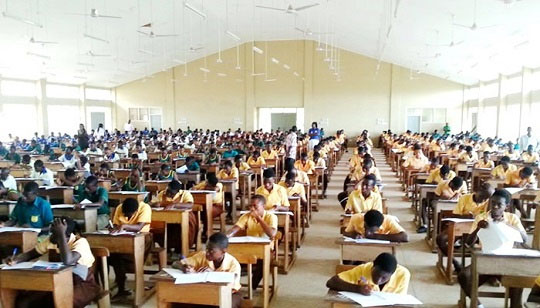
The West African Examinations Council (WAEC) has dismissed claims by private school associations that candidates from private schools were unfairly marked in the 2026 Basic Education Certificate Examination (BECE).
The examination body insists all candidates were treated equally throughout the marking and grading process, describing allegations of discrimination as unfounded.
Speaking in response to concerns raised by the Ghana National Council of Private Schools (GNACOPS) and the Ghana National Association of Private Schools (GNAPS), WAEC’s Head of Public Affairs, John Kapi, said scripts are marked without distinguishing between candidates from public and private schools.
He explained that examiners receive scripts based on examination centres rather than school identities, adding that the use of centre numbers instead of school names on script envelopes prevents examiners from identifying the schools whose scripts they are marking.
Mr. Kapi encouraged candidates and schools with concerns about their results to seek clarification through WAEC’s established review process, assuring the public that the Council is ready to address genuine complaints.
The response follows a petition by GNACOPS to the Minister of Education requesting the establishment of an independent committee to investigate what it describes as persistent disparities between private school students’ continuous assessment performance and their BECE results.
GNACOPS argued that the concerns have persisted over several examination years and submitted assessment records, mock examination results and BECE outcomes as evidence to support its call for an independent review of WAEC’s assessment, moderation and marking processes.
The Greater Accra Regional Chairperson of GNAPS, Dr. Aisha Asi Akrofi, also expressed concern over what she described as disappointing performances by many private school candidates, despite strong academic records before the examination.
She claimed some average-performing students who wrote the examination through public schools obtained better grades than high-performing candidates from private schools.
Meanwhile, education think tank Africa Education Watch (EduWatch) has renewed its call for an independent assessment regulator to oversee examination bodies in Ghana.
Executive Director, Kofi Asare, says although there is no evidence of bias by WAEC, allowing the Council to investigate complaints about its own decisions falls short of international standards of accountability and independent oversight.
He has urged the Ministry of Education to either establish an independent examinations regulator or expand the mandate of the National Council for Curriculum and Assessment (NaCCA) to provide oversight of assessment agencies.