A new Afrobarometer report has revealed that a majority of Africans support women’s rights and autonomy in key personal decisions, but many believe institutions must do more to protect women from discrimination, harassment, and inequality.
The report, titled “Africans endorse women’s rights, and want institutions to do more to protect them,” is based on Round 10 surveys conducted across 38 African countries in 2024 and 2025.
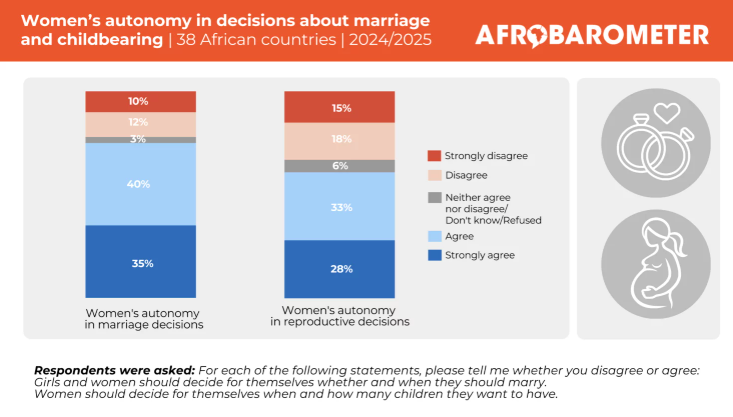
The findings show that most citizens support women having the freedom to make decisions about marriage and childbearing. However, significant gaps remain between public support for gender equality and the realities women face in homes, workplaces, and communities.
According to the report, women continue to lag behind men in household financial decision-making, while some citizens still believe husbands and families can prevent women from taking up employment opportunities.
Although more than half of respondents support equal opportunities for women and men in hiring, researchers noted that unequal access to economic resources, land, finance, and productive assets remains a challenge for many women across the continent.
The report also highlights concerns over sexual harassment and violence against women and girls, including in public spaces and schools. While many citizens expressed confidence that victims who report discrimination or harassment would be believed, a larger proportion called for stronger action from police and the courts to protect women.
Health access was also identified as a major area of concern, with the report indicating that two-thirds of women surveyed said they or their families went without medical care at least once in the previous year. The situation was particularly severe in some rural communities.
The researchers said the findings reveal a disconnect between commitments made by governments and regional institutions on gender equality and the lived experiences of many women.
Gender equality remains a key priority under frameworks including the African Union’s Agenda 2063 and the United Nations Sustainable Development Goals, but the report suggests that more efforts are needed to translate policies into meaningful improvements for women and girls.