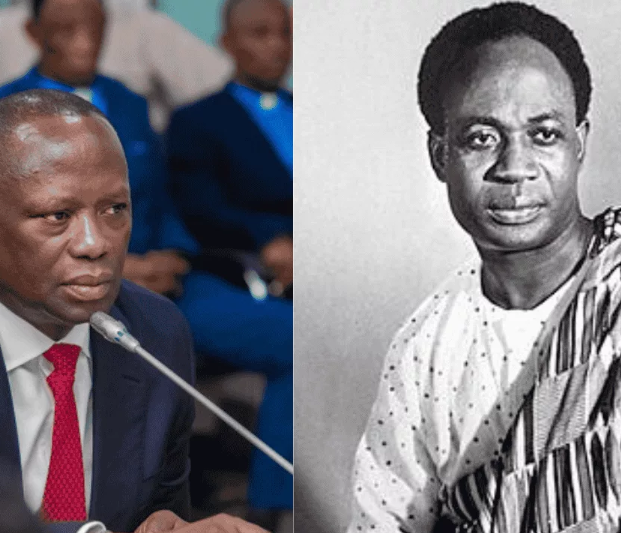
On the 60th anniversary of the overthrow of Ghana’s first President, Kwame Nkrumah, the Member of Parliament for Ellembelle has described the 24 February 1966 coup as “an act of international aggression” that disrupted Ghana’s industrial transformation and Pan-African vision.
Delivering a statement on the floor of Parliament on Tuesday, 24 February 2026, the MP said the events of that day went beyond a mere military takeover and should be understood within the broader geopolitical context of the Cold War.
He argued that what was codenamed “Operation Cold Chop” amounted to a decisive blow to Africa’s liberation project, contending that the removal of Nkrumah stalled Ghana’s long-term development agenda.
“Not Just a Military Coup”
The MP said declassified materials from international archives indicate external involvement in the events leading to Nkrumah’s overthrow, adding that foreign interests were threatened by his Pan-African stance and economic independence agenda.
He referenced remarks previously made by President John Dramani Mahama at Ghana’s 68th Independence Day celebration, which pointed to foreign involvement in the coup that removed Nkrumah while he was on a peace mission to Hanoi during the Vietnam War.
According to the MP, Nkrumah’s pursuit of continental unity and a self-reliant Ghana that controlled its own resources placed him at odds with powerful external actors.
He further maintained that the coup interrupted plans to expand local cocoa processing, domestic oil refining and the growth of a strong manufacturing base.
Reaffirming Nkrumah’s Central Role in Independence
The MP used the anniversary to defend Nkrumah’s legacy amid what he described as attempts at historical revisionism.
While acknowledging the contributions of other nationalists, he maintained that Nkrumah was central to Ghana’s independence struggle, citing the formation of the Convention People’s Party, the “Self-Government Now” campaign and the Positive Action movement that mobilised Ghanaians against colonial rule.
He noted that Nkrumah stood before the world on 6 March 1957 to declare Ghana’s independence, linking the country’s freedom to the total liberation of Africa.
Development Footprints Still Visible
The MP pointed to major national infrastructure projects initiated under Nkrumah as evidence of an enduring legacy, including:
-
Akosombo Dam
-
Tema Harbour
-
Kwame Nkrumah University of Science and Technology
-
Black Star Square
He said these projects were deliberate instruments of national transformation, designed to power industrial growth and economic self-reliance.
Call for Renewed Commitment to Self-Reliance
As Ghana marks six decades since the 1966 coup, the MP called for a renewed commitment to the ideals of self-reliance, Pan-African unity and industrialisation associated with Nkrumah.
He said the vision of economic sovereignty remains unfinished business and urged policymakers to recommit to long-term structural transformation.
The statement adds to ongoing national conversations about Nkrumah’s legacy, Ghana’s development path and the long-term impact of the 1966 coup on political stability and economic transformation.
Source: parliamentnews360.com