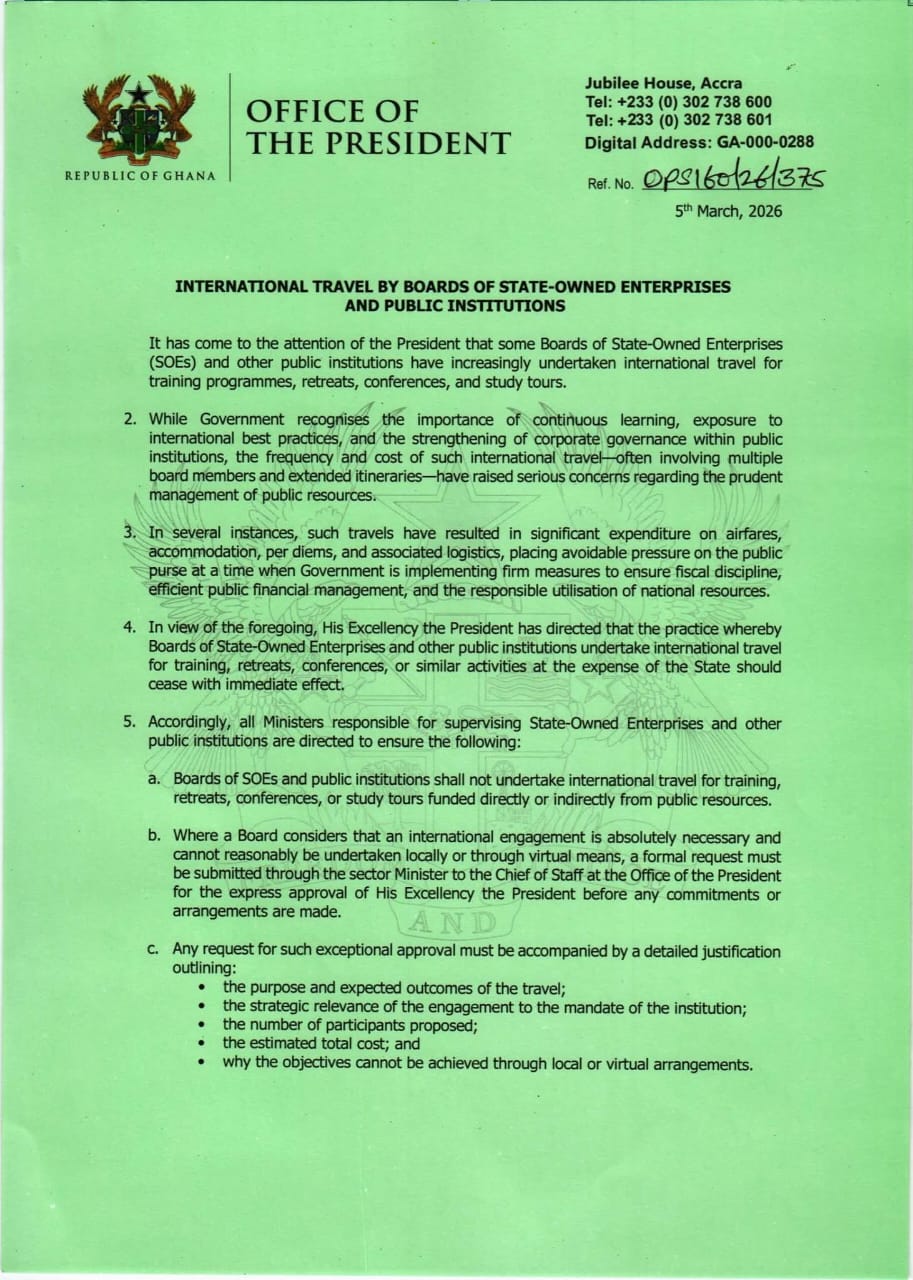
Accra – President John Dramani Mahama has directed boards of State-Owned Enterprises (SOEs) and public institutions to immediately halt all international travel for training, conferences, retreats, and study tours funded by the state, citing rising concerns over public expenditure.
The directive, signed by Secretary to the President Callistus Mahama and issued from Jubilee House on March 5, 2026, aims to strengthen fiscal discipline and ensure prudent management of national resources.
“It has come to the attention of the President that some Boards of State-Owned Enterprises and other public institutions have increasingly undertaken international travel for training programmes, retreats, conferences, and study tours,” the directive noted.
While acknowledging the value of professional exposure, the government said the frequency and cost of such trips have raised serious concerns, adding that these activities often involve multiple board members and extended itineraries, leading to significant expenditure on airfares, accommodation, per diems, and logistics.
“In view of the foregoing, His Excellency the President has directed that the practice whereby Boards of State-Owned Enterprises and other public institutions undertake international travel at the expense of the State should cease with immediate effect,” the statement said.
However, exceptions may be considered under strict approval, requiring a formal request through the relevant sector minister to the Chief of Staff, detailing the purpose, expected outcomes, strategic relevance, number of participants, total cost, and justification for why the objectives cannot be achieved locally or virtually.
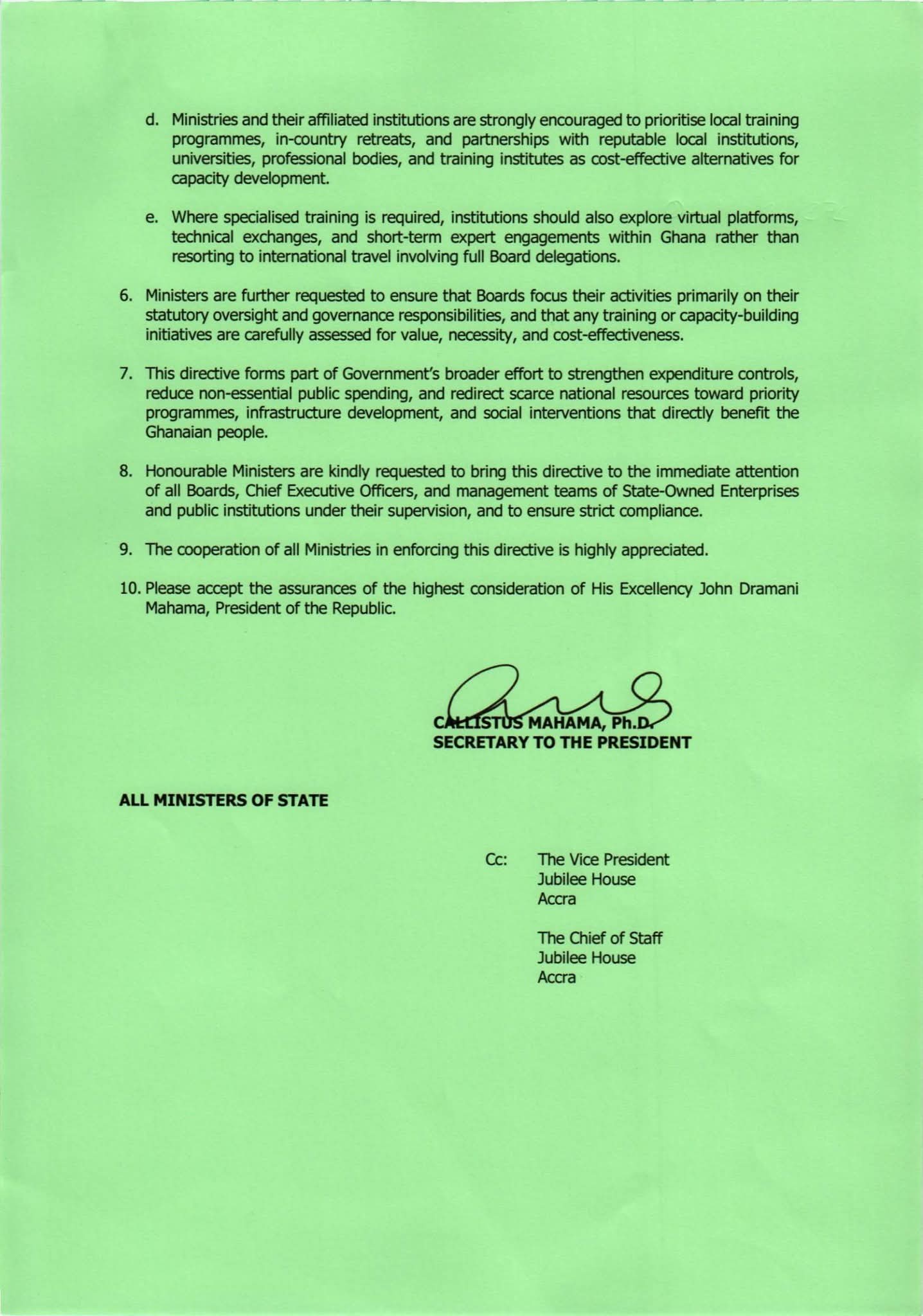
The directive encourages ministries to prioritize local capacity-building programs, including in-country retreats, partnerships with reputable local institutions, and virtual training platforms. Boards are also reminded to focus primarily on their statutory oversight and governance responsibilities, ensuring that any capacity-building initiatives are cost-effective and necessary.
The government emphasized that the policy forms part of a broader strategy to control public spending and redirect resources toward national priorities, infrastructure development, and social interventions that directly benefit Ghanaians.
“All ministers are requested to bring this directive to the immediate attention of all Boards, Chief Executive Officers, and management teams under their supervision, and to ensure strict compliance,” the statement concluded.