Ghana must move beyond simply finding an available hospital bed. We must build an emergency healthcare system that ensures every patient gets to the right facility, at the right time, for the right treatment.
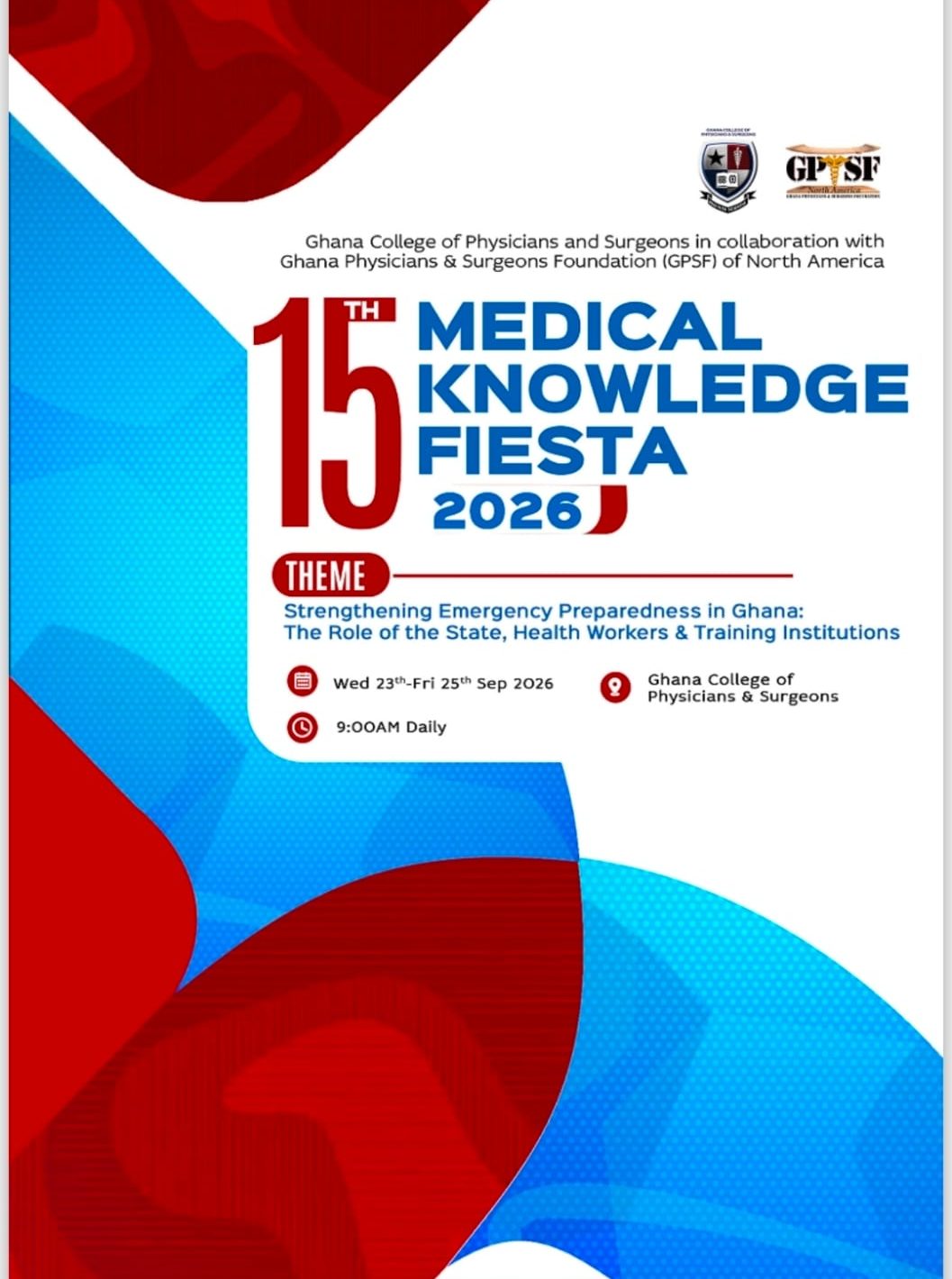
That was the central message I shared during a panel discussion at the 15th Medical Knowledge Fiesta, held at the Ghana College of Physicians and Surgeons in Accra from September 23–25, 2026.
The Fiesta was organized around the theme “Strengthening Emergency Preparedness in Ghana: The Role of the State, Health Workers & Training Institutions.” I was honoured to be invited by the Chair of the Local Planning Committee to participate in a special session titled “Managing Access: The Bed Bureau in Ghana and USA.”
The session featured Dr. Titus Beyuo, Member of Parliament and medical doctor, who presented on the government’s response to Ghana’s persistent no-bed syndrome. The discussion was moderated by Dr. Richard Salomey.
Following Dr. Beyuo’s presentation, I had the opportunity to offer a response informed by my experience working in the United States healthcare system, including my exposure to emergency coordination, hospital systems, and the organization of specialized medical services.
I left the session encouraged by the direction of the initiative and convinced that there is an opportunity to strengthen it further.
1. Recognizing progress: A command centre is a step in the right direction
The no-bed syndrome is a familiar and distressing problem in Ghana. Patients requiring urgent care may be moved from one hospital to another because a facility reports that it has no available beds, cannot accommodate the patient, or lacks the capacity to provide the required treatment.
For patients experiencing heart attacks, strokes, major trauma, surgical emergencies, or other time-sensitive conditions, delays in accessing appropriate care can have devastating consequences.
During the presentation, Dr. Beyuo described the government’s efforts to address the problem through a command centre, technology for tracking bed availability, and a more coordinated approach to emergency referrals.
I welcomed these efforts.
The establishment of a coordinated system for managing hospital access is an important step towards addressing a longstanding challenge in our healthcare system.
The use of technology to identify available beds and facilitate communication between hospitals has considerable potential. It can reduce the time spent searching for a facility, improve visibility across the healthcare system, and support more informed decisions about where patients should be sent.
Rather than dismissing the initiative because the problem is complex, we should acknowledge the progress being made and focus on how the system can work more effectively.
However, a command centre is only as effective as the information it receives, the people making decisions within it, and the clinical capabilities of the hospitals to which patients are referred.
That is where I believe some important refinements are needed.
2. Before hiring more people, let us maximize the workforce we already have
One of the issues I reflected on during the discussion was the proposal to employ additional personnel to support the new system.
My concern was not with the need for skilled personnel. Every effective emergency coordination system requires trained people. Rather, my concern was whether we are fully utilizing the human resources already available within our hospitals and health institutions.
Across many healthcare systems, inefficiencies arise not simply because there are too few workers, but because responsibilities are poorly coordinated, processes are fragmented, and staff are not always deployed in ways that maximize their contribution.
Before creating additional layers of staffing, we should examine existing workflows, management structures, accountability, and opportunities to improve productivity.
Could some of the required functions be integrated into existing hospital operations? Could clearer responsibilities and better information systems improve performance? Could stronger management reduce duplication and delays?
These are questions worth addressing as Ghana implements its emergency coordination strategy.
Technology should help us make better use of our people, not simply create more administrative structures around them.
The objective should be a system that is efficient, accountable, and capable of delivering results without unnecessary duplication.
3. Every hospital needs an effective bed-management function
A central command centre cannot function effectively if it does not have accurate, timely information from individual hospitals.
I believe every hospital should have a designated bed manager or an appropriately organized bed-management function responsible for knowing the hospital’s bed capacity and communicating changes in real time.
This role would go beyond counting empty beds.
The bed manager would need to understand which beds are available, which are occupied, which are being prepared for incoming patients, and which beds can safely accommodate patients with particular needs. The function would also require close coordination with the emergency department, inpatient wards, discharge teams, and hospital leadership.
In my view, this function should be closely integrated with nursing operations, with a clear reporting relationship to the nursing supervisor or director of nursing, while maintaining appropriate accountability to hospital management.
The precise structure can be adapted to the size and organization of each facility.
The essential point is that bed management must be an active operational function rather than an occasional administrative exercise.
Real-time information is critical
Electronic health information systems should communicate bed availability to the command centre in real time, or as close to real time as technically feasible.
If a patient needs admission, the system should help the coordinating team identify where an appropriate bed is available without requiring repeated telephone calls to multiple hospitals.
This requires more than purchasing software. It requires reliable data, interoperable systems, clear protocols, designated personnel, and a commitment from every participating facility to keep information current.
A bed-tracking system that displays outdated information may create a false sense of availability and lead to further delays.
The technology must reflect what is happening on the ground.
4. The right bed is not enough. The patient must reach the right hospital.
This was one of the most important points I wanted to emphasize.
The goal of emergency coordination must not be merely to send a patient to the next hospital with an available bed. The goal must be to get the patient to a facility capable of providing the treatment required.
A hospital may have an empty bed but lack the specialist, equipment, surgical service, or critical-care capability needed to manage a particular emergency.
Sending a patient to that facility may only delay definitive treatment and necessitate another transfer.
Consider two examples.
A patient with a suspected aortic dissection
Aortic dissection is a life-threatening condition in which the inner layer of the aorta tears. Depending on the location and severity, the patient may require urgent specialist assessment and, in some cases, emergency cardiothoracic surgical intervention.
The appropriate destination is not simply the nearest hospital with an available bed. It is a facility with the diagnostic capacity, specialist expertise, and intervention capabilities required for that patient’s condition.
A patient experiencing an acute stroke
Time is critical in acute stroke care. Some eligible patients may benefit from intravenous thrombolysis, while others may require evaluation for endovascular thrombectomy, depending on their clinical presentation, imaging findings, timing, and available services.
The referral system must therefore identify stroke-capable facilities and direct patients to the appropriate level of care without avoidable delays.
These examples illustrate why bed availability and clinical capability must be considered together.
A sophisticated emergency coordination system should know not only where beds are available, but also what each hospital can actually do.
5. Lessons from the United States: Coordination, transport, and specialized care
My perspective is informed by my professional experience in the United States, including my work in North Dakota.
Emergency medical systems require coordination across multiple levels: emergency call and dispatch services, ambulance teams, hospitals, specialist centres, and, where appropriate, air medical transport.
The effectiveness of such systems depends on defined protocols, communication, trained personnel, transport infrastructure, and an understanding of which facilities can manage particular conditions.
The underlying principle is that patients should be directed according to their clinical needs, not simply according to which hospital answers the telephone first.
For Ghana, this means developing a coordinated referral network that connects the command centre with emergency medical services, district and regional hospitals, teaching hospitals, and specialized centres.
It also means establishing clear pathways for time-sensitive conditions such as major trauma, stroke, acute cardiac emergencies, and other conditions requiring specialized interventions.
Not every hospital needs to provide every service. But the system must know which services are available, where they are available, and how patients can reach them safely and promptly.
Ghana can adapt lessons from other countries while designing a system that reflects our own geography, resources, workforce, referral patterns, and healthcare infrastructure.
The objective is not to replicate another country’s system wholesale. It is to identify what works, learn from experience, and implement solutions suited to our context.
6. What should the next phase look like?
As Ghana moves forward with its command centre and bed-tracking initiative, I believe several priorities deserve attention.
1. Establish real-time bed visibility
Connect participating hospitals through reliable electronic systems that communicate bed availability and update changes promptly.
2. Strengthen bed management within hospitals
Designate responsible personnel, clarify reporting lines, and integrate bed management with nursing, emergency, inpatient, and discharge operations.
3. Embed clinical expertise in the command centre
Ensure referral decisions take account of the patient’s condition, urgency, required specialist services, and the receiving hospital’s capabilities.
4. Coordinate referrals and emergency transport
Establish clear protocols connecting dispatch services, ambulances, receiving hospitals, and specialized centres, including air transport where appropriate.
5. Build a network of centres of excellence
Map facilities with defined capabilities for stroke, cardiac emergencies, major trauma, and other conditions requiring specialized care.
6. Measure outcomes and continuously improve
Track referral delays, time to definitive treatment, inappropriate transfers, bed turnover, and patient outcomes to identify gaps and improve performance.
These priorities should be developed collaboratively by government, hospital administrators, clinicians, nurses, emergency medical services, technology teams, and other stakeholders.
They also need to be supported by clear standards, appropriate funding, ongoing training, and mechanisms for evaluating whether the system is actually improving patient care.
7. An invitation to collaborate
I appreciated the opportunity to hear Dr. Titus Beyuo explain the government’s initiative and to contribute my professional perspective to the discussion.
My response was not a rejection of the initiative. On the contrary, I see it as an opportunity to build on an important foundation.
The next step is to ensure that the technology, workforce, hospital operations, transport systems, and clinical referral pathways function as one coordinated system.
I expressed my willingness to work with Dr. Beyuo and other interested stakeholders to explore how these recommendations could be translated into practical improvements.
Ghana has clinicians, nurses, administrators, engineers, technology professionals, and other experts whose experience can contribute to this effort. Our diaspora also offers opportunities for knowledge exchange and collaboration with health systems around the world.
We should draw on these resources in a structured and purposeful way.
The success of this initiative should ultimately be judged not by the number of beds displayed on a screen or the number of referrals processed, but by whether patients receive timely, appropriate care and whether avoidable deaths and complications are reduced.
Beyond finding a bed: Saving lives
The no-bed syndrome is not merely a problem of physical space. It is also a problem of coordination, information, management, transport, and access to specialized clinical care.
A command centre can help address these challenges, but its full potential will only be realized when it is connected to efficient hospital operations and clinically informed referral decisions.
We must move from asking, “Which hospital has a bed?” to asking, “Which hospital can provide the care this patient needs, and how do we get the patient there in time?”
That is the standard to which we should aspire.
I commend the efforts to address this longstanding challenge and look forward to constructive engagement on how Ghana can continue to strengthen its emergency healthcare system.
Every patient deserves timely access to the right care. Every avoidable delay matters. And every improvement we make should bring us closer to a healthcare system that saves more lives.
I welcome thoughtful contributions from healthcare professionals, policymakers, hospital leaders, technology experts, and all those committed to strengthening emergency care in Ghana.
By Dr. Bertha Serwa Ayi, MBChB, FACP, FIDSA, MBA | Infectious Diseases Specialist | Clinical Assistant Professor of Medicine, University of North Dakota, USA