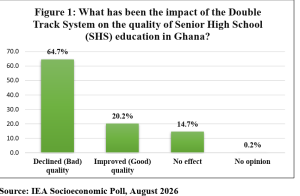
A new socioeconomic poll by the Institute of Economic Affairs (IEA) has found that nearly two-thirds of Ghanaians believe the Double-Track System has negatively affected the quality of Senior High School (SHS) education.
The August 2026 survey, which involved 1,062 respondents across Ghana’s 16 regions, recorded 64.7% saying the system had resulted in a decline in the quality of SHS education.
The IEA stated that, “64.7% of Ghanaians believe the Double-Track System has had a negative effect on the quality of SHS education.”
Only 20.2% of respondents considered the system to have improved educational quality, while 14.7% said it had made no difference. A further 0.2% had no opinion.
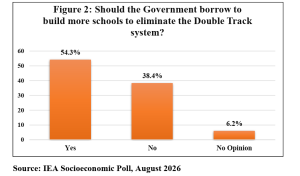
The poll also examined whether government should borrow to expand SHS infrastructure and ultimately phase out the Double-Track System.
According to the findings, 54.3% supported additional borrowing for the construction of more schools, compared with 38.4% who opposed the idea. Another 6.2% were undecided.
Support for borrowing was even higher among respondents who felt the Double-Track System had harmed education quality, with 60.8% of that group backing the construction of additional schools through borrowing.
The IEA said the findings point to significant public demand for expanded SHS infrastructure, while also highlighting concerns about the fiscal consequences of financing such projects through borrowing.
The Double-Track System was introduced as a temporary intervention to increase access to secondary education in the face of inadequate infrastructure.
While the arrangement allowed more students to enter SHS, the latest poll shows that a majority of respondents associate it with a decline in the quality of education.