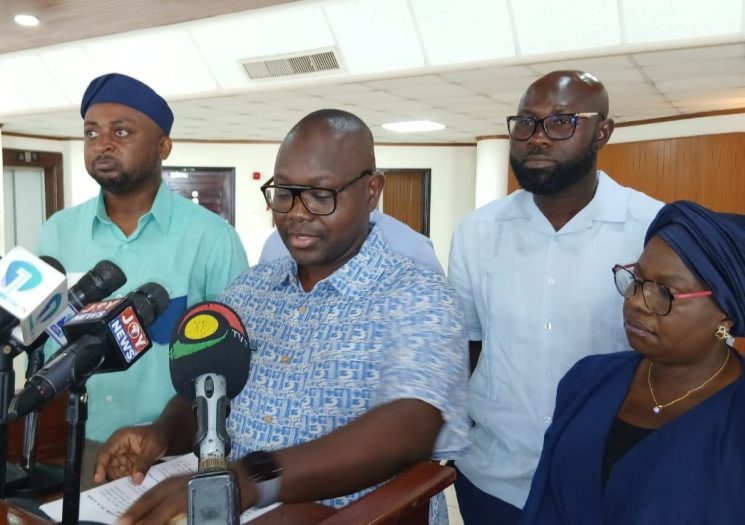
The Ashanti Caucus of Parliament has launched a scathing attack on the government’s decision to “shortchange” the people of Kumasi by scaling down the Suame Interchange Project from its original four-tier design to a two-tier configuration.
Describing the downgrade as technically unsound and a disservice to Ghana, the Caucus warned that the move undermines years of rigorous urban planning and threatens to lock the Ashanti regional capital into decades of avoidable traffic congestion.
Leading the charge, Member of Parliament for Bantama and former Roads Minister, Francis Asenso-Boakye, argued that the reduction fundamentally compromises the project’s integrity.
While the Ministry of Roads and Highways cited debt-related challenges and contractor drawdown issues for the revision, the Caucus isn’t buying it.
“A two-tier solution will not eliminate conflict points… it will merely shift congestion from one junction to another,” Asenso-Boakye stated, adding that under-designing is often worse than doing nothing at all.
The Caucus raised eyebrows over the government’s “Big Push” road program, questioning how GH¢43 billion can be allocated to road infrastructure this year while a strategically vital project like Suame is being hollowed out.
The MPs argue that these funding limitations appear to be selective, noting that if resources were successfully mobilized for the Ofankor–Nsawam Road, there is no technical justification for shortchanging Suame.
Furthermore, they stressed that the four-tier plan was the result of rigorous traffic modeling and engineering assessments rather than arbitrary choices, asserting that as a national transit hub, Kumasi requires infrastructure that matches its strategic importance to the national economy.
The original design, finalized in 2024 after extensive utility relocations, was intended to be a comprehensive solution for the city’s transport woes.
Under this blueprint, the lost components of Phase One include a massive four-tier interchange at the Suame Roundabout, which served as the project’s hub, alongside strategic elevated overpasses at Krofrom Junction and critical underpasses at Abrepo Junction to manage traffic flow.
The plan also factored in the widening of the Kumasi Inner Ring Road, a move specifically designed to accommodate projected traffic growth and prevent the area from becoming a permanent bottleneck.
The Ashanti Caucus is demanding an immediate reversal of the decision, urging the government to reprioritize its funding to honor the original engineering specs. They cautioned that the current path would lead to contractual disputes, cost overruns, and a bottleneck that would stifle the city’s economic potential.
For the MPs, this isn’t just about concrete and steel—it’s about political justice and economic wisdom for Ghana’s second-largest city.